


I’m OBSESSED with the FLEX formula!! 😍 It’s so smooth, creamy, fast and easy to work with. I seriously love it!
Couldn't load pickup availability


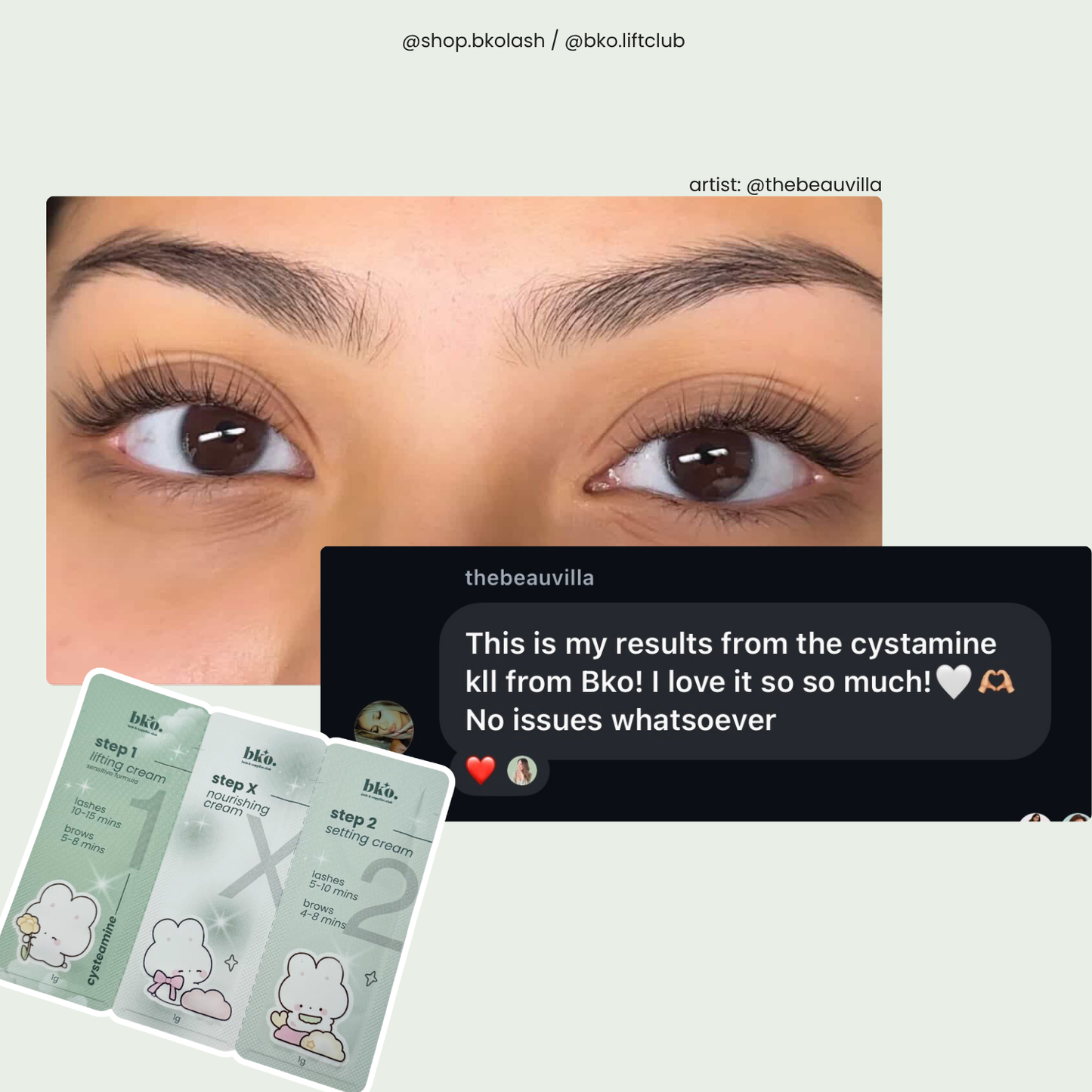
every korean lash lift works the same basic way: step 1 breaks apart the disulfide bonds holding your client's lashes in their natural shape, so the hair can be reshaped around the rod. step 2 then reforms those bonds in the new, curled position — locking the shape in place. the difference between ZOOM, FLEX, and STANDARD comes down to which reducing agent step 1 uses to break those bonds, and how fast it can do it.

ZOOM's step 1 is built on ammonium thioglycolate, the salt form of thioglycolic acid and the most widely used reducing agent in professional perming. it breaks disulfide bonds quickly and reliably, which is why ZOOM processes fastest of the three (8–10 min). we reformulated it with a thicker base consistency, so it holds onto the lash without a separate viscosity powder.
FLEX uses cysteamine in its free-base form — a smaller, gentler reducing molecule than thioglycolate. the tradeoff is that pure (free-base) cysteamine is inherently unstable on its own, so our manufacturers incorporate skincare-like ingredients into the formula specifically to help keep the molecule controlled and stable. that's where FLEX's "skincare-like" feel actually comes from — it's a stabilizing necessity as much as it is a gentleness benefit.
STANDARD uses the same active ingredient as FLEX — cysteamine — but in its hydrochloride (HCl) salt form. in this form, the molecule needs to shift out of its protonated state before it can start reducing disulfide bonds, which is what makes STANDARD's processing time longer and steadier (10–15 min). that slower activation curve is exactly what gives you more visual control over how far the curl develops.
(the HCl salt form is inherently more stable than free-base cysteamine, which is part of why STANDARD doesn't need the same stabilizing ingredients FLEX does.)
once the lashes are set on the rod, step 2 re-oxidizes those broken bonds back into disulfide bonds in their new shape. all three bko formulas use hydrogen peroxide as that oxidizer, rather than sodium bromate (a common alternative in traditional perm neutralizers). the chemistry is the same regardless of which step 1 you chose — ZOOM, FLEX, and STANDARD all finish with the same step 2 reaction.
still not sure which step 1 is right for your client? take the quiz below — it takes less than a minute, and no email required.
Overall rating: 5.0 / 5 from 22 reviews.
I’m OBSESSED with the FLEX formula!! 😍 It’s so smooth, creamy, fast and easy to work with. I seriously love it!

I absolutely love the ZOOM system! One of the first things I noticed was that it doesn’t have that strong smell that some lash lift solutions have, which makes the experience so much nicer for both me and my clients. I also LOVE that the processing instructions are printed directly on each sachet. It’s such a small detail, but as a working artist, it makes the system so convenient and easy to use without having to stop and look up instructions during a service. The system has been easy to work with, gives me beautiful, consistent results, and has quickly become one of my favorites for Korean lash lifts. Definitely a product I’m happy to keep in my backbar!

OBSESSED with the BKO Lift System! ✨ As a lash tech, I’m always looking for products that are easy to work with AND give the prettiest results, and this system does both! The formulas are so easy to use, and the lifts come out sooo clean, lifted & fluffy every time❤️🔥 Definitely one of my new favorites in my lash lift routine! Thank you BKO for the cutest PR package! 🫶🏼✨

my favorite KLL solution!! works so well and effectively and i always find myself having the best lifts with it!

This lift system is such an amazing system! I love the consistency & literally EVERYTHING BKO!!

I love ittttt, and the smell not crazy like other brand I was used

I absolutely LOVED both FLEX and ZOOM + HEAL! 🤍 ZOOM is SO fast! As someone who’s newer to Korean Lash Lifts, it seriously helped me cut down my service time. I was taking around 1.5–2 hours before, and using ZOOM I was able to finish in about an hour! 😭 FLEX is my ABSOLUTE FAV though 😍 It smells sooo good — even my clients comment on how much they love the smell — and I love that it still processes so quickly. I’ve been really happy with the results I’ve gotten while still being able to prioritize the health of my clients’ natural lashes. HEAL has also been such a nice finishing step to condition and give the lashes some extra love after processing. They don’t look dry AT ALL. These are my client’s results using FLEX + HEAL 🤍 Safe to say these products have officially made their way into my KLL routine! @latinalashspot

I used the FLEX system here and it turned out absolutely amazing!

Love bko lift system!! super gentle and easy to work with, and it doesn’t strip the hair from any moisture. Only use it for lashes, but yesterday I used it on my brows and I love it.

By far the best KLL system I’ve tried! Super gentle and beginner friendly! It’s so gentle that I feel it’s hard to over process lashes with this system! Love and always have it stocked in my suite 💗

I used the flex system and I am OBSESSED! 😍 Yes, it did take a bit longer than the TGA System, but it put me at ease, knowing that there is a very, very low risk of over processing! Will definitely be repurchasing🫶🏾

This was my first time using ZOOM on a client, and I’m seriously impressed! My client has naturally straight, stubborn lashes that can be difficult to lift, but ZOOM worked so quickly and gave us a beautiful lift while still maintaining the integrity and health of her natural lashes. The formulation was easy to work with, effective, and delivered exactly what I was looking for without overprocessing. I absolutely love the results and can’t wait to use it on more clients. Definitely a new favorite!

I love the formulation and how gentle it is on the lashes! This client has very thick long lashes that usually take much longer with other formulations but BKO was amazing! Will definitely be repurchasing 🤩

We love using Zoom, it works fast and gives us amazing results. definitely repurchasing Zoom. Couldn't live without it.

I can confidently say the BKO Korean lash lift solution exceeded every expectation. From the very first application, I noticed how gentle yet incredibly effective the formula was. My clients have consistently achieved beautifully lifted, healthy-looking lashes with and the results speak for themselves. If you're a lash artist looking to elevate your services, this solution is absolutely worth adding to your kit <3

Vicki is such a great instructor. She truly cares about her students and her products. I purchased her KLL course and the products are great!! I was scared to use TGA but once you understand how it works and you put everything together the results are to die for! This is a KLL I did + extensions.

My new favorite lash lift system! I used the gentle formula to get these amazing results . I love how affordable this is too 💚

Such a great product! It smell is very minimal and it works so quick! All of my clients have had no complaints and felt no irritation! I love how it not only has the perm and neutralizer but also the nourishing cream because you don’t have to go out and find one for your product! There’s enough product in the packages you will have a lot extra to work with!
Had a hard time deciding on what brand to go through and decided to go with bko. No regrets at all! Used for a first time lash lift with no issues and I loved the extras!! Thank you!
Amazing
I’ve done one lift with your product and so far it’s very spot on and consistent
I am in love with this cystemine system!! I normally use this mainly (still love the speedier formula for thicker lashes!) but this one makes me feel a ton safer with the slower processing time and allows me to feel confident that my clients will process low and slow and gives me time to tidy up my work area in between steps lol. I will always have this in stock!